A New Concept of Self Learning

Self learning is a motivation and the best way to improve your knowledge and skills to glow in the crowd

self learning

Practice Brings Perfection

Practice, practice and Only practice. The more you practice the more you can utilize your knowledge and make yourself accurate.

Increase Your Memory

Smart way of learning has made it easier to design your memory accordingly and increase your ability to remember.

e-=learning

Smart Learnig, E-Learning

Learning has no boundary. The more you learn the more your exposure to the world.

online education

Education is a better safeguard

Self education is the best policy to stand on your own feet and not to be dependant.

June 17, 2018

Problems on Ages


Problems on ages come both in bank exams and SSC exams, but the frequency that is the number questions on problems on ages is not very high. There are so many formulas on age problems which definitely reduce your time in examination hall but what if you don’t remember the formula at the time of exam or you can not recognize the formula? Well, this is why I am sharing some tricks to solve problems on ages with question and answers.

Q1.  A father is twice as old as his son. 20 years beck he was twelve times as old as his son. What is the present age of father?


Answer: Here I have tried to explain the whole process graphically.


problems on ages
Figure 1

Then,


age calulator
Figure 2
Now, here we have calculated that the time period is 10, but we have been given that the time period is 20 years. 
So
(20/10) * 22 
[father’s present age as derived in the figure above]
= 2 * 22 = 44 years.

Q2. 5 years ago, age of Sachin was 4 times the age of Vineet and after 10 years, Sachin will be twice as old as Vineet. Find the present ages of Vineet.

Answer: Graphical Presentation,

age calculator
Figure 3
After that,

Figure 4

Now, here we have found out the total time period, from 5 years ago to 10 years after, which is 2. But according to the questions the total time period is 15 years.
So, the present age of Vineet is

(15/2)  * 1 + 5 
7.5 + 5 = 12.5 years.


June 16, 2018

How to find Square Root

square root


How to find square root of 5 digit number, square root of 4 digit number or square root of any number without calculator has now become very easy. To find square roots you need to remember certain things that will help you find square roots quickly.

Let’s take a look,

The tricks to find square roots in seconds you have to remember this chart.

Number
Square
Last Digits
0
0
0
1
1
1
2
4
4
3
9
9
4
16
6
5
25
5
6
36
6
7
49
9
8
64
4
9
81
1


Now Carefully see the the following chart to find how square roots are derived.


Note that in 5th column, if (d) that is the value of (c)*(c+1) is greater than the first two digits of the example [28 in the example 2809 or 50 in the example 5041] that is 30>28 or less than the first two digits of the example that is 72<73 in column 6th, then the last digit of the answer will be accordingly, derived from the 7th column (f) of the chart.


So this is how the square of any number is derived quickly even without calculator. One suggestion, the more you practice the more quickly you can calculate square roots.

In the similar way you can also find the Cube Roots


June 10, 2018

How to find Cube Root

cube root tricks


To find the cube root of a number you have to keep in mind certain rules and also squares & cubes of numbers, at least 2 digit number, which are necessary. Click here. Here I will show you how to find Cube roots of numbers in seconds.

Step 1
Keep in mind cubes of numbers up to 9 from 0.

   Chart
Number
Cube
Last digit
0
0
0
1
1
1
2
8
8
3
27
7
4
64
4
5
125
5
6
216
6
7
343
3
8
512
2
9
729
9

Step 2: 
Now let’s take examples to figure out how to find cube root of any number.

1728 and 21952 are the examples. To find the cube root first of all you have to ignore last three digits. To find cube root you always have to ignore the last three digits.

Number
Ignore Last 3 digits
1728
728
21952
952

Step 3:
Now considering the number of remaining digits that is the first 1, 2 or 3 digits, we have remember the lower cube to this number. Like, 13 = 1 for the number 1728 after ignoring 728, 23 = 8 which is lower than 21 of the number 21952 after ignoring 952. So we select 1 and 2 for the numbers respectively.


Now notice that the last digit of 1728 or 21952 is 8 and 2 respectively which are the last digits of cubes of 2 and 8 respectively. So we take 2 and 8 respectively.


cube root


June 6, 2018

How to solve Calendar Maths

calendar math tricks

How to solve calendar mathematics is a great fun. Here you will get the idea about how to solve calendar math problems and can help yourself  find the day of a week for both Ordinary Year and Leap Year and even find the day of the week without knowing any particular given dates.

Days Gain or Loss

When we move forward or backward by 1 year, then 1 day is gained or lost.
Example: 8th July 2014 was Friday, then 8th July 2015 would be = Friday + 1 = Saturday.
If 4th February 2014 was Monday, then 4th February 2013 would be = Monday - 1 = Sunday.

When we move forward or backward by 1 leap year, then 2 days are gained or lost.

Example: 24th December 2011 was Tuesday, then 24th December 2012 would be
Tuesday + 2 = Thursday.

If  17th December 2012 was Tuesday, then 17th December 2011 would be
Tuesday - 2 = Sunday.

[Note: For finding the days in leap years the day must have crossed 29th of February, or else 1 should be added instead of 2.]

  • Find a Particular Day on the basis of Given Day and Date

If 5th March 1999 was Friday, what day of the week was it on 9th May 2000?

Ans: The number of days between 5th March 1999 and 9th May 2000,

 Since 5th March 1999 was Friday then 5th March 2000 would be

Friday + 2 = Sunday 

[2000 is leap year and 5th March has crossed 29th February.]

After 5th March 2000 we have 26 days of March + 30 days of April + 9 days of May = 65 days.

In 65 days we have 9 weeks and 2 odd or extra days.

So, 5th March 2000 is
Sunday + 9 Weeks 
= Sunday + 2 odd or extra days 
= Tuesday.

  • Find a Particular Day without Given Date and Day

Mahatma Gandhi was born on 2nd October 1869. What was the day of the week?

Ans: The nearest Century to 1869 is 1600.

To come to 1869 we have 1600 + 200 + 68

1600 = 0 odd days

200 = 3 odd days

68 = (17 leap year + 51 ordinary year)

So, 1600 + 200 + 68 = Sum of odd days

      = 0 + 3 + (17*2 + 51*1)

      = 0 + 3 + 85 = 88

      = 12 weeks + 4 odd day (88/7= 12 wk + 4 days)

Now total odd days from January to 2 October of 69 or 1869

(odd days are derived by dividing total days of a month by 7, and the remaining are odd days)

January = 3     February = 0
March = 3       April = 2
May = 3         June = 2
July = 3         August = 2
September = 2   October = 2 (up to birth day date)

Total days = 23 = 3 weeks + 2 odd days

So, 4 odd days + 2 odd days = 6 days.

Therefore, 2nd October 1869 is Saturday.


Calendar Math Tricks

  • Ordinary Year

A year having 365 days is called an Ordinary Year, which has

(52 complete weeks + 1 Extra/Odd day)

  • Leap Year

A Leap Year has 366 days (including 29th of February) and

(52 complete weeks + 2 Extra/Odd days)

  1. A leap year is divisible by 4, like 1984, 1988, 2008, 2012 etc.
  2. A century is divisible by 400, like 1600, 2000, 2400 etc.
  3. Centuries like 1700, 1800 are not divisible by 400.

  • Odd Days

  • Number of odd days in Ordinary Year
365 days = (52 weeks*7) + 1 odd day.
  • Number of days in a Leap Year
366 days = (52*7) + 2 odd days.
  • Number of odd days in a Century (100 year)
100/4 = 24 leap year + (100 - 24 = 76) 76 ordinary year.

(76*1 + 24*2)[since ordinary year has 1 odd day and leap yeas has 2 odd days]

124 days = 7 week*17 + 5 odd days.
  • Number of Odd days in 200 year
= 5*2 [since 100 year has 5 odd days and here it is 200 year]

10 odd days = 1 week + 3 odd days.
  • Number of Odd days in 300 year
5*3 = 15 odd days 
=2 week + 1 odd day.
  • Number of Odd days in 400 year
5*4 + 1 = 21 odd days
=3 weeks + 0 odd days.
[since 400th year is a leap year, so 1 more day is added]


June 4, 2018

HCF and LCM

  • Find the largest number which divide 1356, 1868 and 2764 leaving the same remainder in each case.
Ans: From the Solution Methods the required number is,
HCF of (1868-1356), (2764-1356) and (2764-1868)
HCF of 512, 1408 and 896
lcm and hcf
So the HCF = 8*8 = 64. Since there are only two 8s in common.

  • Find the greatest number that divides 130, 305 and 245 leaving remainders 6, 9 and 17 respectively.
Ans: From the Solution Methods required number is,
HCF of [(130-6), (305-9), (245-17)]
HCF of 124, 296, 228
lcm and hcf example
So the HCF is 4.

  • Find the number which when divided by 12, 16 and 18 leaves 5 as remainder in each case.
Ans: From the Solution Methods we see that,
(LCM of 12, 16, 18) + 5

So LCM = 2*2*3*4*3 = 144
Required number is 144 + 5 = 149.

  • Find the largest possible number of 5 digits which is exactly divisible by 32, 36 and 40.
Ans: From the Solution Methods we see that,
LCM of 32, 36 and 40 = 1440.
The greatest 6 digit number is 99999
lcm hcf example
So the required number = 9999-639 = 99360.

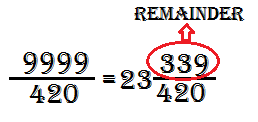
  • Find the greatest 4 digit number which when divided by 10, 15, 21 and 28 leaving remainders 4, 9, 15 and 22.
Ans: From the Solution Methods we get,
LCM of 10, 15, 21 and 28 = 420.
The largest 4 digit number is 9999
lcm and hcf
So four digit number divisible by 10, 15, 21 and 28 = 9999-339 = 9660.
Also k = 10-4 = 15-9= 21-15= 28-22 = 6
Required number is 9660-6 = 9654.


June 3, 2018

LCM and HCF

lcm and hcf

LCM and HCF of Fractions

  • LCM of fractions = (LCM of numerators)/(HCF of denominators)

  • HCF of fractions = (HCF of numerators)/(LCM of denomenators)

Solution Methods:

  • Product of two numbers = HCF of the numbers * LCM of the numbers.
  • The greatest number which divides the numbers x, y and z, leaving remainders a, b and c respectively is given by
HCF of (x-a), (y-b), (z-c)

  • The least number which when divided by x, y and z leaves the remainders a, b and c respectively is given by
LCM of (x, y, z) - k
where,   K = (x-a) = (y-b) = (z-c)

  • The least number which when divided by x, y and z leaves the same remainder k in each case, is given by
LCM of (x, y, z) + k

  • The greatest number that will divide x, y and z leaving the same remainder in each case is given by
HCF of (x-y), (y-z), (z-x)

  • The greatest n - digit number which when divided by x, y and z:
      (a) Leaves no remainder
Requires number = n-digit greatest number - R
      (b) Leaves remainder k
 Required number = [n-digit greatest number - R] + k

where R is the remainder obtained when n-digit greatest number is divided by the LCM of x, y and z.

  • The smallest n-digit number which when divided by x, y ans z leaves
      (a) No remainder
Required number = [n-digit smallest number  + (L-R)]
     (b) Remainder k
Required number = [n-digit smallest number + (L-R)] + k

where, R is the number obtained when n-digit smallest number is divided by LCM of x, y, and z. L is the LCM of x, y and z.


June 2, 2018

Number Series

Math short tricks

  • n² Series

Find the missing term in the series 4, 16, 36, 64, ..., 144.
Ans: This is a series of squares of consecutive even numbers.
2² = 4, 4² = 16, 6² = 36, 8² = 64, 10² = 100

  • (n² + 1) Series

Find the missing term in the series 10, 17, ..., 37.
Ans: Series pattern
3² + 1 = 10, 4² + 1 = 17, 5² + 1 = 26

  • (n² - 1) Series

Find the missing term in the series 0, 3, 8, ..., 24.
Ans: Series pattern
1² - 1 = 0, 2² - 1 = 3, 3² - 1 = 8, 4² - 1 = 15

  • (n² + n) Series

Find the missing term in the series 12, 20, 30, 42.
Ans: Series pattern
3² + 3 , 4² + 4, 5² + 5, 6² + 6

  • (n² - n) Series

Find the missing term in the series 42, 30, ..., 12, 6.
Ans: Series pattern
7² - 7, 6² - 6, 5² - 5, 4² - 4, 3² - 3

There are some other series that follow the same rule like n³, (n³ + 1), (n³ - 1), (n³ + n), (n³ - n). I will suggest do it yourself.

  • Alternating Series

Find the next term in the series 15, 14, 19, 11, 23, 8, ...
Ans: Series pattern

Number series


June 1, 2018

Boat and Stream Formulas


  • If speed of stream is ‘a’ and a boat (swimmer) takes ‘n’ times as long to row up as to row down the river, then
Speed of Boat (swimmer) in still water = a*(n+1)/(n-1)

  • A person can row at a speed of ‘x’ in still water. If stream is flowing at a speed of y, it takes time ‘T’ to row to a place and back, then
Distance between two places = T*(x2 – y2) / 2x

  • A man rows a certain distance downstream in ‘x’ hour and returns the same distance in ‘y’ hour. When the stream flows at the rate of ‘a’ km/h, then
Speed of the man in still water = a*(x+ y) / (y – x)

  • If boat’s speed in still water is ‘a’ km/h and river is flowing with a speed of ‘b’ km/h, then average speed in going to a certain place and coming back to starting point is given by
(a + b)(a – b) / a km/h

  • When boat’s speed in still water is ‘a’ km/h and river is flowing with a speed of ‘b’ km/h and time taken to cover a certain distance upstream is ‘T’ more that the time taken to cover the same distance downstream, then
Distance = (a2 – b2)*T / 2b

  • If a man covers ‘I’ km distance in ‘t1’ hour along the direction of the river and he covers same distance in ‘t2' hour against the direction of the river, then
Speed of man = 1/2 * (I/t1 + I/t2)
Speed of stream = 1/2 * (I/t1 – I/t2)


May 31, 2018

Basic Number Theory


  • Square of every even Number = An even Number
  • Sum of first ‘n’ natural numbers = {n(n+1)}/2
  • Sum of first ‘n’ odd numbers = n2
  • Sum of first ‘n’ even numbers = n(n+1)
  • Sum of square of first ‘n’ natural numbers = {n(n+1)(2n+1)}/6
  • Sum of cubes of first ‘n’ natural numbers = {n(n+1)/2}2
  • There are 15 prime numbers between 1 & 50 and 10 prime numbers between 50 & 100
  • If n divides p & q, then n divides their sum and difference also
      Like: 6 divides 12 & 18, then 12+18 = 30 and 18-12 = 6 are also divided by 6

  • For any natural number n, (n3 – n) is divisible by 6
  • The product of three consecutive natural numbers is always divisible by 6
  • (xm – am) is divisible by (x – a) for all values of m
  • (xm – am) is divisible by (x + a) for even values of m
  • (xm + am) is divisivlke by (x + a) for odd values of m
  • Number of prime factors of ap bq cr ds is p+q+r+s, where a, b, c, d are prime numbers